The Names, the Legends, and the Lives Written Into Sunset Cliffs' Stone
Most people who visit Sunset Cliffs come for the view. They leave with a photograph, maybe a sunburn, and the kind of quiet satisfaction that only a really good sunset can produce. What they rarely leave with is the sense that the ground beneath their feet has been shaped not just by the Pacific Ocean, but by more than a century of human ambition, heartbreak, ceremony, and myth.
But it has. And once you know some of these stories, the cliffs stop being just a backdrop and start feeling like a place with a memory.
The Man Who Tried to Turn the Cliffs Into a Resort
The name "Sunset Cliffs" didn't emerge organically from local usage — it was a marketing decision. In the early 1920s, a developer named John P. Scripps (part of the prominent Scripps family that shaped much of San Diego's early development) had ambitions for this stretch of coastline that went well beyond a walking path.
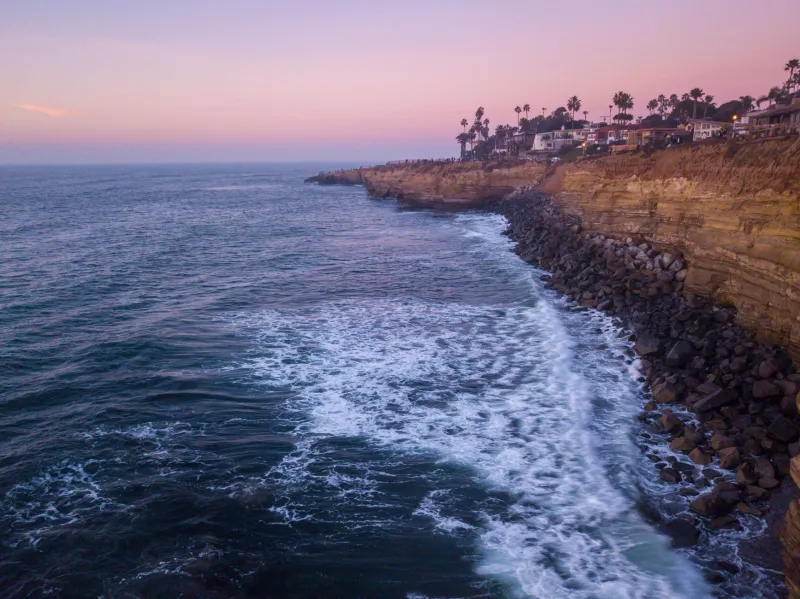
Scripps envisioned a high-end resort community — a rival to the grand coastal developments springing up along Southern California at the time. He commissioned roads, planted palm trees, and gave the area its now-iconic name as part of a promotional campaign designed to attract wealthy buyers from across the country. The concrete seawall that still lines parts of Ocean Boulevard? That's a remnant of his infrastructure investment.
The resort never materialized the way Scripps imagined. The cliffs were too dramatic, the terrain too uneven, and the ocean too relentless to be fully domesticated. But the name stuck, the palms grew, and the road he built became one of San Diego's most beloved coastal drives. The cliffs, in other words, outlasted the plan.
The Arch and What It's Said to Mean
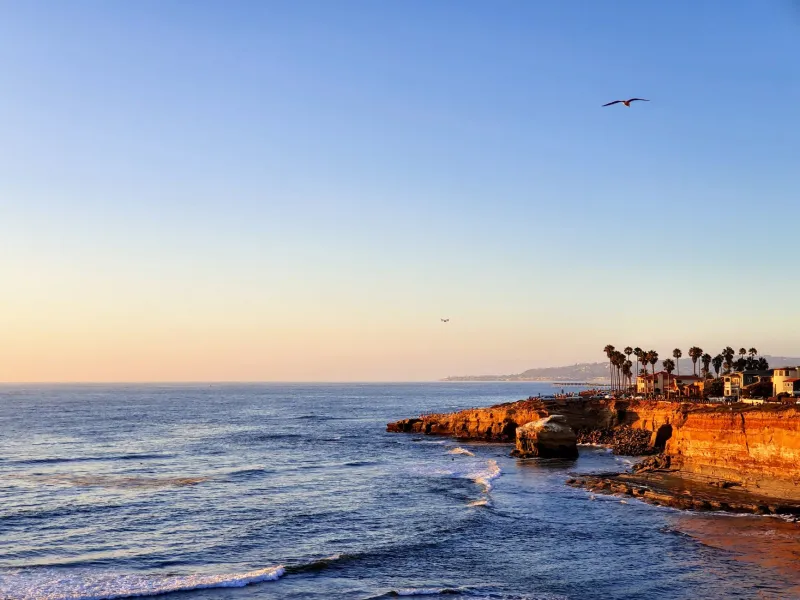
Among the most photographed formations along the cliffs is a natural sea arch — a curved opening in the rock where the ocean has carved through over thousands of years of wave action. Geologically, it's a straightforward example of differential erosion: softer rock wearing away faster than harder volcanic basalt, eventually creating a tunnel that water passes through at high tide.
Locally, it means something else entirely.
Longtime Ocean Beach residents will tell you that the arch has been a de facto proposal spot for decades — not officially designated, not marked on any map, just passed down through the community as a place where people come to make promises. More than a few couples claim their relationships were sealed there, standing at the edge of the arch with the Pacific crashing below. Whether the setting creates the romance or the romance creates the mythology is a question nobody seems particularly interested in resolving.
What's certain is that the arch draws a specific kind of visitor — people who know the story and want to be part of it, even briefly. On weekend mornings, it's not unusual to find small groups gathered there, some photographing, some just standing quietly, as if the stone itself has something to say.
The Tide Pools and the Scientists They Inspired
Before Sunset Cliffs became a destination, it was a laboratory. The rocky intertidal zones along this stretch of coastline were studied by early marine biologists connected to the Scripps Institution of Oceanography, which was established nearby in the early 1900s. The tide pools here — filled with sea stars, anemones, hermit crabs, and dozens of other species — were among the first on the West Coast to be systematically documented.
That scientific heritage left a quieter legacy than the resort development did, but it's arguably more durable. The Sunset Cliffs Natural Park designation, which protects a significant portion of the coastline from development, owes something to those early researchers who understood that this ecosystem was worth preserving. When you crouch down to look at a sea anemone in one of the lower tide pools, you're looking at the same community of organisms that those early scientists were cataloging a hundred years ago.
The Memorial Flowers and What They Represent
If you walk the cliffs regularly, you'll notice something that first-time visitors often miss: small clusters of flowers, sometimes candles, occasionally photographs, tucked into crevices in the rock or placed at the edge of overlooks. These informal memorials appear and disappear with the tides and the weather, but they're almost always there in some form.
Sunset Cliffs has long been a place where San Diegans bring their grief. Families scatter ashes here. Friends gather to mark anniversaries of losses. Strangers leave flowers at spots that meant something to someone who is no longer around. There's no official designation for this practice — no ceremony, no permit required — just a shared, unspoken understanding that this is a place where the boundary between presence and absence feels thin.
Local surfers have their own version of this tradition: the paddle-out memorial, where friends and family paddle into the water on surfboards and form a circle to honor someone who has died. It's a ritual with roots in Hawaiian surf culture that has been adopted up and down the California coast, and Sunset Cliffs is one of its most common San Diego settings. The combination of the cliffs as witness and the ocean as vessel gives these ceremonies a weight that's hard to articulate and impossible to forget if you happen to witness one.
The Cave That Has a Name (and a History)
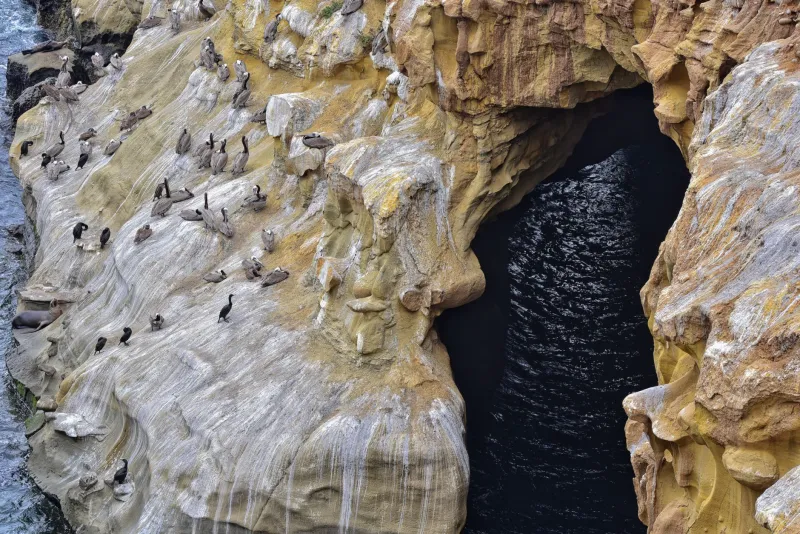
Along the lower sections of the cliffs, accessible only at low tide and only with careful footing, are several sea caves carved into the base of the sandstone. One of these — known locally simply as "the big cave" — has been a gathering spot for generations of Ocean Beach teenagers, surfers, and wanderers.
The cave doesn't appear on official maps. It doesn't have a formal name in any city document. But ask anyone who grew up in OB and they'll know exactly which one you mean. The walls have been marked and remarked over the decades, layers of paint and carving accumulating like geological strata. It's not exactly a historical monument — but it is a record of everyone who felt compelled to leave a mark on a place that had already marked them.
Accessing it requires checking tide tables, wearing shoes with real grip, and accepting that you'll probably get your feet wet. The city's safety advisories about the lower cliffs are genuine and worth heeding. But for those who make the effort at the right moment, the cave offers something the main overlooks never can: the feeling of being inside the cliffs rather than on top of them, with the ocean moving just outside the entrance and the sound filling every corner of the stone.
A Landscape That Keeps Writing Itself
The stories attached to Sunset Cliffs aren't finished. New ones are being added constantly — by the couple who just got engaged at the arch, by the family who came to say goodbye to someone they loved, by the kid from Ocean Beach who found a sea cave and felt, for the first time, like the world was enormous and full of possibility.
The geology is always changing too. Sections of the cliff face erode and fall. New formations emerge. The ocean is patient and relentless in a way that puts all of human history in perspective. But the human stories accumulate anyway, layered into the rock alongside the fossils and the tide marks, waiting for the next person who shows up curious enough to look.