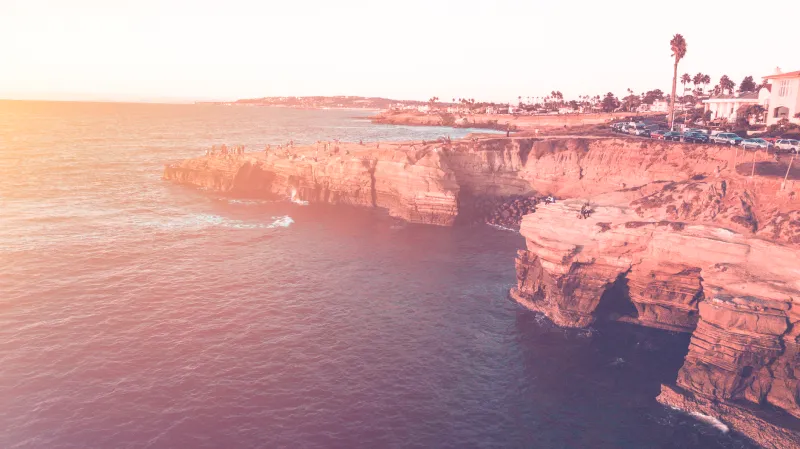
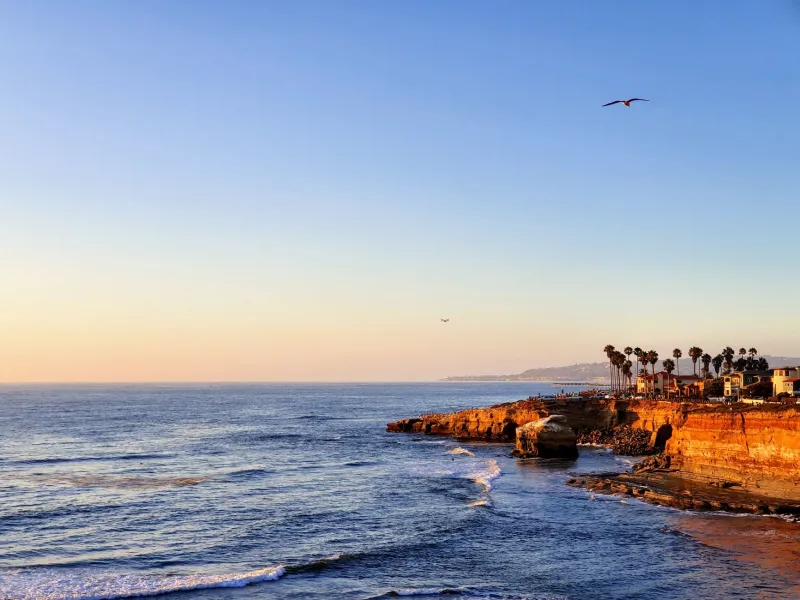
Why So Many People Make Their Biggest Life Decisions Standing on These Cliffs
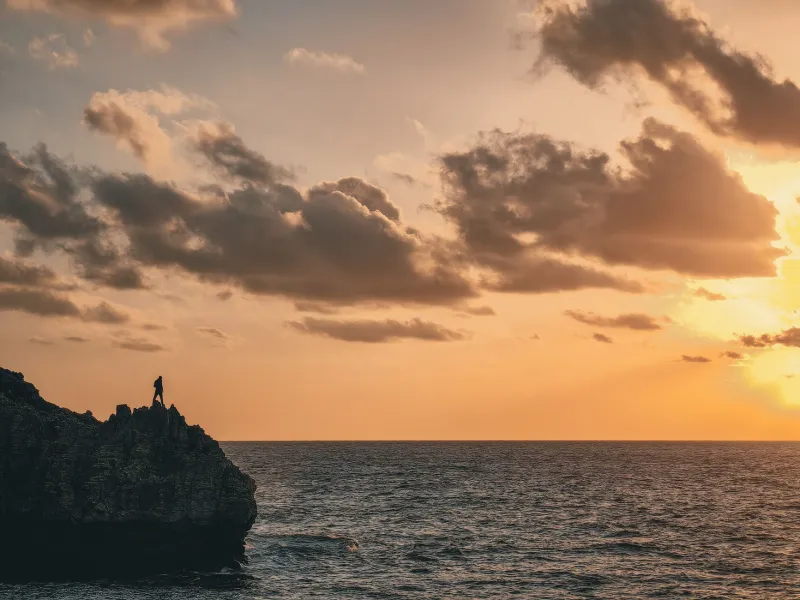
Kayla didn't drive to Sunset Cliffs to figure out her life. She drove there because she needed somewhere to sit and eat a breakfast burrito without her roommates asking questions. Forty minutes later, she was texting her landlord to give notice on her apartment. She'd been thinking about moving to Portland for two years. Somehow, staring out at the Pacific from a slab of sandstone in Ocean Beach made the whole thing feel obvious.
"I wasn't even thinking about it," she says. "And then I just... was. And then I just knew."
She's not alone. Spend enough time talking to people at Sunset Cliffs and a pattern emerges that's hard to dismiss as coincidence. People come for the view and leave with a decision. Sometimes a small one. Sometimes the kind that reshapes the next decade.
So what's actually happening out there on those rocks?
The Brain on Big Water
Marine biologist and author Wallace J. Nichols popularized the term "blue mind" to describe the mild meditative state humans tend to slip into near large bodies of water. The research behind it suggests that proximity to water—especially moving water with a visible horizon—quiets the brain's default mode network, the mental chatter loop responsible for rumination, anxiety, and overthinking.
When that loop slows down, something interesting happens: the brain gets better at integrating information it's already been processing in the background. Problems that felt tangled suddenly look simpler. Options that seemed equally weighted start to sort themselves.
In plain terms, the ocean doesn't give you new information. It just helps you hear the information you already had.
Sunset Cliffs is particularly well-suited to this effect. The cliffs themselves create a kind of natural amphitheater—you're elevated, exposed to open sky, and facing an unobstructed stretch of the Pacific. There's nothing to look at except water, horizon, and light. The visual field is simultaneously vast and simple, which researchers believe encourages a state of "soft fascination," a term from Attention Restoration Theory describing environments that hold your attention without demanding it.
Why Elevation Changes the Way You Think
There's also something worth noting about the physical position the cliffs put you in. You're above the waterline, looking out and slightly down. That specific vantage point—elevated, expansive, forward-facing—has been linked in psychology research to what's called "construal level" thinking. Basically, when you feel physically elevated, your brain tends to shift toward more abstract, big-picture processing rather than getting stuck in immediate details.
It's the same reason people say they get their best ideas on airplanes or mountain hikes. Height, even modest height, nudges the mind toward longer time horizons and broader perspectives.
At Sunset Cliffs, you're not standing on a mountain. But you are standing above the crash zone, watching waves that traveled thousands of miles to reach the shore. That combination of elevation and scale seems to do something to the way people frame their own circumstances.
The Permission Structure of a Place That Doesn't Know You
Dr. Sarah Pressman, a health psychologist at UC Irvine who studies positive emotion and wellbeing, has noted that novel environments—places outside our daily routine—can function as what she calls "permission spaces." When we're in a familiar context, we're constrained by who we've already been in that context. The office, the apartment, the coffee shop where everyone knows our order—these places carry the weight of our existing identity.
A place like Sunset Cliffs, especially for visitors who don't live in San Diego, carries none of that. You're anonymous. The cliffs don't know what you said you were going to do and didn't. They don't know what you've been afraid to admit. That absence of social and psychological context can make it easier to think thoughts you've been unconsciously avoiding.
For locals, the effect is slightly different but still real. Many San Diego residents describe the cliffs as a kind of reset button—a place they go specifically when they need to think something through without the static of their regular life getting in the way.
The Role of Awe
Psychologists Dacher Keltner and Jonathan Haidt have studied awe extensively, and their findings keep showing up in conversations about places like Sunset Cliffs. Awe—the feeling triggered by something vast that challenges your existing mental frameworks—has a measurable effect on the sense of self. Specifically, it tends to shrink it.
That sounds negative, but it isn't. When your sense of self gets smaller relative to what you're experiencing, something called the "small self" effect kicks in. You feel less burdened by your personal narrative, less attached to the specific story you've been telling yourself about who you are and what you're supposed to do. That loosening creates space for different kinds of thinking.
The view from Sunset Cliffs is genuinely awe-inducing—not in a performative way, but in the quiet, almost unsettling way that comes from standing at the edge of a continent and watching the sun drop toward water that doesn't end. It's the kind of view that makes your problems feel both smaller and more solvable at the same time.
What People Actually Decide Out There
The decisions people report making at Sunset Cliffs tend to cluster around a few themes. Career changes come up constantly—people deciding to leave jobs they've tolerated for too long, or finally committing to something they've been building on the side. Relationship decisions are common too, though they go in both directions: some people decide to end things, others decide to stop taking something for granted.
A surprising number of people mention health-related choices—not dramatic ones, but quiet commitments to take better care of themselves. And then there's a category that's harder to name: people who describe simply deciding to stop waiting. To stop treating their actual life as something that starts after some future condition is met.
None of these decisions require a dramatic setting to be made. People make them in parking lots and grocery store aisles all the time. But something about the cliffs seems to make them stick.
Getting the Most Out of Your Visit
If you're heading to Sunset Cliffs specifically to think something through, a few practical notes:
Go on a weekday if you can. The crowds on weekend evenings are real, and solitude matters here. A Tuesday morning with a thermos of coffee hits differently than a Saturday sunset with fifty strangers doing the same thing.
Give yourself more time than you think you need. The first fifteen minutes are usually just decompression. The interesting thinking tends to happen after that.
Find a spot away from the main overlooks. The cliffs stretch for nearly a mile. Walk south past the more photographed sections and you'll find quieter ledges where you can actually hear yourself think.
Leave the headphones out. The sound of the surf is doing work. Let it.
Nobody's promising you'll walk away with a life-changing decision. But there's a reason people keep showing up here at their crossroads, and it's not entirely about the view—though the view certainly doesn't hurt.