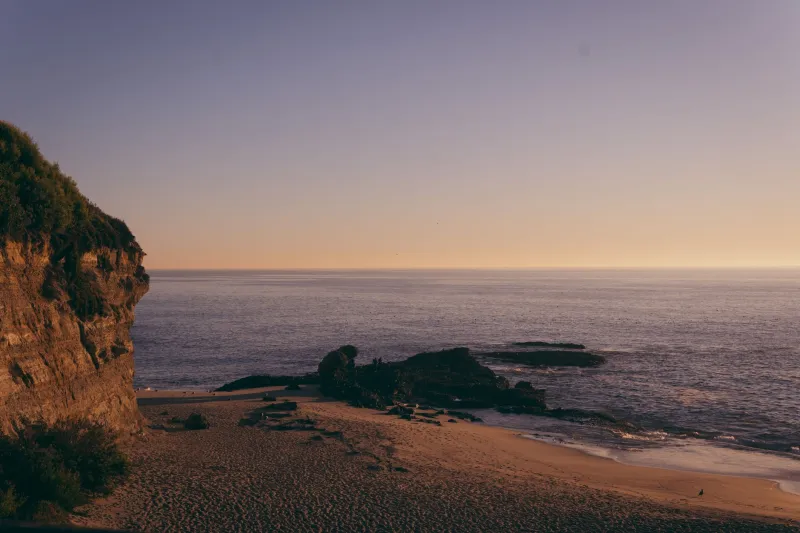
Why Sunset Cliffs Outlasts Everything Else in Your San Diego Memory

San Diego is not short on things to do. You've got one of the most celebrated zoos on the planet, a sprawling cultural park, a historic waterfront, and enough taco shops to fuel a week of serious exploration. So why is it that when people flip back through their mental highlight reel from a San Diego trip, so many of them land on the same image — standing on a jagged shelf of rock, salt air in their face, watching the Pacific light up like something out of a painting?
Sunset Cliffs keeps winning that competition. Not because it has a gift shop or an entry fee or a ranger handing you a map. It wins because of something harder to package.
The Zoo Is Incredible. Sunset Cliffs Is Personal.
Let's be clear: the San Diego Zoo is legitimately world-class. Balboa Park is a cultural treasure. Nobody's arguing otherwise. But here's the thing about those experiences — they're curated. You follow a path, read the plaques, move through a sequence someone else designed for you. That's not a criticism; it's just the nature of those spaces.
Sunset Cliffs doesn't do any of that. You show up, you find a rock, and then it's just you and a few hundred miles of open ocean. There's no narration. No suggested route. No gift shop nudging you toward the exit. The experience is almost entirely self-directed, which turns out to matter enormously when it comes to how strongly a memory gets encoded.
Psychologists who study autobiographical memory have long noted that experiences we choose and navigate ourselves tend to leave deeper impressions than those we're guided through. When you discover your own perfect perch at the cliffs — maybe a flat ledge tucked below the main path, or a tide pool shelf nobody else seems to have noticed — that sense of discovery is yours. It doesn't belong to a brand or an institution. That's a significant part of why it sticks.
What Repeat Visitors Actually Say
Spend enough time talking to people at Sunset Cliffs and a pattern emerges fast. You'll meet folks on their second San Diego trip who skipped Seaport Village this time around but made sure to come back here. You'll run into couples who got engaged somewhere along this coastline and return every anniversary. You'll find solo travelers who built their entire itinerary around catching one specific sunset from one specific spot they read about or stumbled onto the first time through.
One repeat visitor from Portland described it this way: "The Zoo was amazing — I took a hundred photos of the giraffes. But I couldn't tell you exactly when that happened or how I felt standing there. At Sunset Cliffs, I remember everything. I remember the exact color of the sky, I remember being cold, I remember thinking I'd never seen anything like it."
That kind of vivid, emotionally textured recall is not an accident.
The Science of Why This Place Gets Under Your Skin
There's a concept in environmental psychology called restorative experience — the idea that certain natural settings trigger a specific kind of mental reset that goes beyond simple relaxation. Researchers have found that coastal environments, particularly those with dynamic features like waves, shifting light, and dramatic elevation, are especially effective at producing this state.
Sunset Cliffs hits nearly every marker. The rhythmic sound of waves breaking against the rocks has a measurable calming effect on the nervous system. The wide, unobstructed horizon encourages what psychologists call soft fascination — a gentle, effortless form of attention that lets the mind wander and recover from the cognitive overload of daily life. And the sheer scale of the view — ocean stretching to the edge of visibility, sky taking up more of your field of vision than you're used to — has a well-documented effect of making personal anxieties feel temporarily smaller.
Combine all of that with the golden-hour light that this particular stretch of coastline is famous for, and you've got conditions that are almost engineered by nature to produce a memorable emotional experience.
How It Compares to Other Famous California Viewpoints
California is not lacking for dramatic coastline. Big Sur gets the magazine covers. Malibu gets the celebrity sightings. Marin Headlands gets the Golden Gate backdrop. Each of those places is genuinely spectacular in its own right.
But locals and frequent California travelers often note something distinct about Sunset Cliffs: it's accessible without being crowded in the way that changes the experience. Big Sur requires a road trip and some planning. The Marin Headlands can feel more like a scenic overlook than a place to sit and breathe. Sunset Cliffs sits inside a real neighborhood — Ocean Beach — which means it has a lived-in, unpretentious quality that many of California's more famous viewpoints have lost.
You're not performing the experience of being at a famous place. You're just... there. Watching pelicans glide past. Listening to the water move through the sea caves below. Letting the light do what it does.
The Neighborhood Makes It Real
Part of what separates Sunset Cliffs from a purely scenic destination is its context. Ocean Beach — the neighborhood that wraps around it — is one of San Diego's most character-rich communities. Surf shops, vintage stores, a farmers market on Wednesdays, and a general attitude that prioritizes being outside over being online. When you visit the cliffs, you're not just visiting a viewpoint. You're briefly inhabiting a way of life.
That context adds texture to the memory. You walked through a real place to get there. You maybe grabbed a coffee from a local spot first. You passed a guy walking a dog and a kid on a skateboard. By the time you reached the cliffs, you'd already absorbed something of the neighborhood's energy, which makes the payoff feel earned rather than instant.
Why Some Memories Last and Others Fade
Memory researchers talk about something called the peak-end rule — the idea that we tend to judge and remember an experience based on how it felt at its most intense moment and how it ended, rather than averaging out the whole thing. Sunset Cliffs, almost by design, delivers on both counts. The peak is the view itself — genuinely jaw-dropping for most first-timers. And the ending, if you time it right, is a sunset that fades slowly enough that you feel the loss when it's finally gone.
That combination — emotional peak followed by a gradual, beautiful close — is the kind of experience structure that memory holds onto.
So when you get back home and someone asks about your San Diego trip, don't be surprised if you lead with the cliffs instead of the zoo. It's not that the zoo wasn't worth it. It's that Sunset Cliffs did something different to you — something quieter, more personal, and apparently a lot harder to forget.