How One Afternoon at Sunset Cliffs Quietly Ruined Every Future Vacation
Ask anyone who's visited Sunset Cliffs about their favorite beach since, and watch their face do something complicated. There's usually a pause. Maybe a small, slightly guilty smile. Then something like, "It was nice, but..." followed by a shrug that says everything.
That "but" is the Sunset Cliffs effect in action.
It's not dramatic. Nobody comes home from Ocean Beach dramatically swearing off all other coastlines. What happens is quieter and, honestly, more permanent. The cliffs get into your head and set up shop. They become the invisible measuring stick you didn't ask for but now can't put down.
What Actually Happens to Your Brain Out There
Let's get into the weeds a little, because there's real science behind why certain places stick and others don't.
When we encounter something that hits multiple senses simultaneously — the deep boom of waves against rock, the salt spray, the way the light turns molten gold at golden hour, the physical sensation of wind on your face while standing on an actual geological edge — our brains treat it differently than a passive experience. Neuroscientists call this "embodied memory." It's stored not just as a mental image but as a full-body imprint.
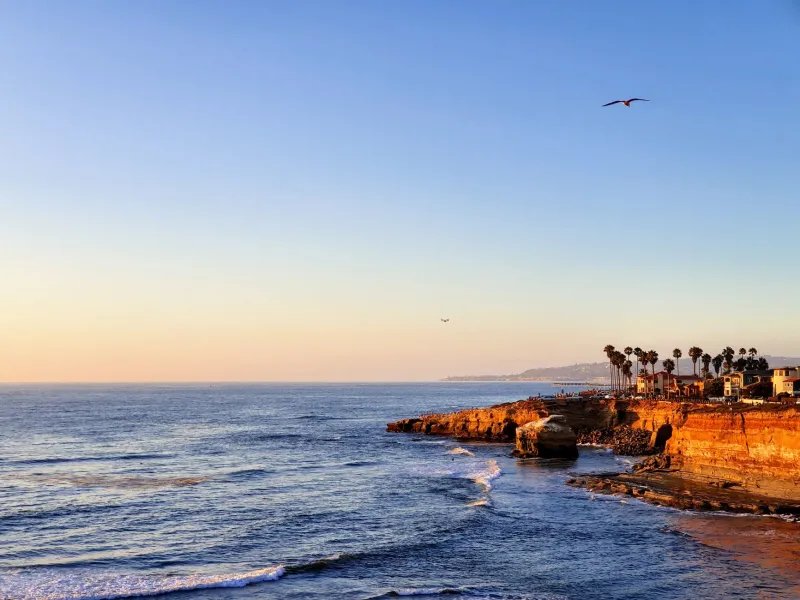
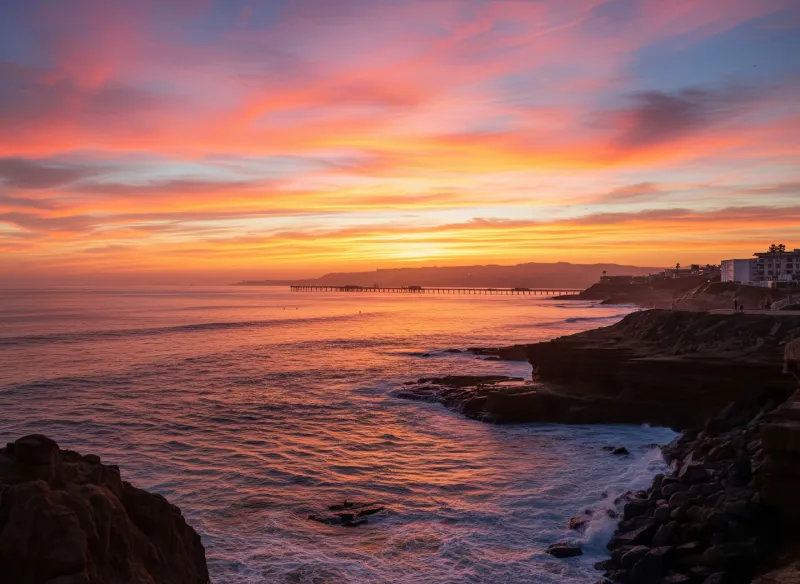
Sunset Cliffs is basically a perfect storm of embodied memory triggers. The dramatic topography means you're physically elevated, which already primes your brain for heightened awareness. The volcanic rock formations create unpredictable acoustics. The Pacific horizon is unbroken for miles. And then the sunset itself — which, on a clear San Diego evening, genuinely looks like someone turned the saturation dial to maximum — delivers a visual payoff that the brain files under "exceptional" rather than "pleasant."
Once something gets filed under "exceptional," it becomes a reference point. Every similar experience afterward gets compared to it, whether you intend that or not.
The Repeat Visitor Phenomenon
Talk to enough people who've been to Sunset Cliffs and you start noticing a pattern: a surprising number of them have been back more than once. Not because San Diego is particularly close to where they live, but because the first visit left something unfinished.
Marcela, a graphic designer from Austin who first visited in 2019, describes driving two hours out of her way during a California road trip just to swing through Ocean Beach and spend an hour at the cliffs. "I couldn't justify it on paper," she says. "But I kept thinking about it the whole drive up the coast. I needed to see if it was as good as I remembered."
It was. She's been back twice since.
This kind of gravitational pull is something travel psychologists actually study. There's a concept sometimes called "destination loyalty" — the tendency to return to places that delivered an emotionally significant experience. Most loyalty is built through comfort and familiarity. What makes Sunset Cliffs unusual is that the loyalty seems to be built through intensity. People don't come back because it's easy. They come back because it meant something.
The Benchmark Nobody Wanted
Here's where things get a little bittersweet. Because the flip side of having a travel benchmark that good is that it genuinely does change how you experience other places.
Jamie, a teacher from Ohio who honeymooned in San Diego, puts it plainly: "We went to the Outer Banks the following summer and the beach was beautiful. But I kept thinking, 'The water isn't the right color. The cliffs aren't there.' My husband felt it too. We didn't say it out loud for like two days because we felt bad, but we were both comparing."
This isn't a knock on the Outer Banks, which has its own very real magic. It's just an illustration of how a sufficiently powerful experience reshapes your internal reference library. Once Sunset Cliffs is in there, it doesn't leave quietly.
Travel writers sometimes call this the "peak experience problem" — when one destination sets a bar so high that it inadvertently diminishes the enjoyment of subsequent trips. The fix, to the extent there is one, is usually to stop comparing and start experiencing each place on its own terms. Easier said than done when your baseline is lava rock formations at the edge of the Pacific at sunset.
How It Changes the Way People Plan Future Trips
One of the more interesting downstream effects of the Sunset Cliffs experience is what it does to people's travel decision-making. Several visitors described a noticeable shift in how they approach trip planning afterward.
Before Sunset Cliffs: optimizing for convenience, hotel proximity, things to do, restaurants nearby.
After Sunset Cliffs: actively hunting for the version of "that feeling" in every destination they consider.
"I started researching places specifically for their geology," says Derek, a software developer from Seattle who visited during a bachelor party trip. "I never cared about rocks before. Now I'm looking at coastal cliffs in Ireland, in Portugal, in Oregon. I'm not chasing a copy of Sunset Cliffs — I know that doesn't exist — but I'm chasing the feeling of standing somewhere that feels ancient and enormous and real."
That's a pretty significant shift in travel philosophy to trace back to one afternoon in San Diego.
What Makes This Place Different From Other "Bucket List" Spots
The obvious question is: why Sunset Cliffs specifically? San Diego has no shortage of beautiful coastline. California has plenty of dramatic scenery. What is it about this particular stretch of rocky shoreline in Ocean Beach that hits different?
A few things seem to converge here that don't always line up elsewhere.
First, it's accessible without being manicured. Sunset Cliffs Natural Park is a real, wild place with real hazards — crumbling sandstone, unpredictable surf, no guardrails telling you exactly where to stand. That slight edge of danger keeps your senses sharp in a way that a perfectly maintained boardwalk doesn't.
Second, the community around it is genuinely local. The surfers out on the water, the photographers set up at their favorite spots, the couples watching the sunset — these aren't tourists performing tourism. They're people who come here regularly because it matters to them. That authenticity is contagious.
And third — and this is the hardest one to quantify — there's something about the specific quality of light on the San Diego coast at dusk. The marine layer, the angle of the sun, the way it reflects off the water and bounces up against the pale rock. It's a particular kind of beautiful that photographs only partially capture, which might be exactly why people feel compelled to return in person.
Living With the Benchmark
If you haven't been to Sunset Cliffs yet, this might all sound a little dramatic. How transformative can a beach really be?
That's a fair question. And the honest answer is: go find out for yourself. Arrive around 6 PM on a clear evening. Find a spot on the rocks. Watch what the light does as it drops toward the horizon. Pay attention to how you feel standing there.
Then go home, plan your next trip somewhere else, and see if you catch yourself doing that small, complicated pause when someone asks if it was your favorite.
Welcome to the benchmark. Most people who've got it wouldn't trade it, even on the trips where it makes everything else feel like a runner-up.