Chasing Likes to the Edge: The Hidden Danger Behind Sunset Cliffs' Most Viral Photo Spots
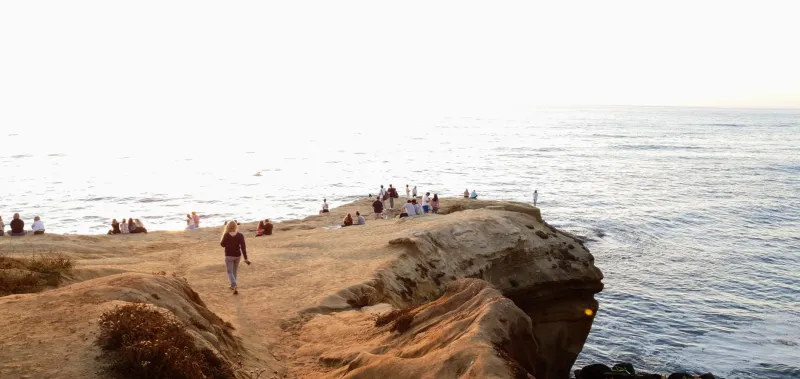
Scroll through Instagram or TikTok for about three minutes and you'll find it — that image. You know the one. A silhouetted figure perched on a rocky outcropping, golden light pouring across the Pacific, waves exploding against the cliff face below. It looks cinematic. It looks effortless. It looks like something you absolutely need to recreate on your next trip to San Diego.
What it doesn't look like is dangerous. But according to San Diego lifeguards and Ocean Beach area rangers, that's exactly what it is.
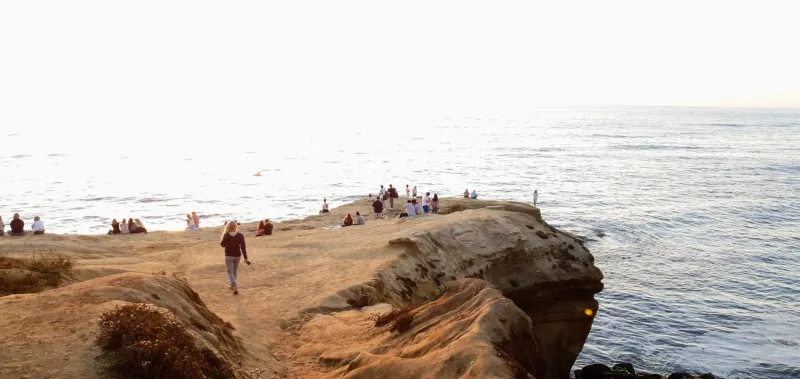
Sunset Cliffs Natural Park is genuinely one of the most photogenic stretches of coastline in the entire country. The sandstone formations, the tidepools, the light at golden hour — it's all real, and it's all stunning. But a growing pattern of viral social media content has quietly turned a handful of specific overlooks into pilgrimage destinations for visitors who don't always understand what they're standing on. And some of those spots are crumbling — literally.
The Ground Beneath Your Feet Isn't What It Looks Like
Here's a geology refresher that doesn't require a degree to understand: the cliffs at Sunset Cliffs are made of sedimentary sandstone, and they've been getting undercut by wave action for thousands of years. The process is ongoing. Chunks of cliff edge don't announce themselves before they break off. There's no warning crack, no dramatic rumble. One moment the ledge is there; the next it isn't.
Rangers and lifeguards in the area have documented repeated incidents at the same small cluster of spots — locations that, not coincidentally, show up again and again in viral social media posts. The connection isn't subtle. When a photo of a specific rocky perch gets tens of thousands of shares, foot traffic to that exact spot spikes within days. And when foot traffic spikes at an unstable sandstone edge, the risk of a serious fall goes up with it.
The San Diego Fire-Rescue Department has responded to multiple cliff rescue calls along Sunset Cliffs Boulevard in recent years, with a notable concentration near the southern end of the park around Ladera Street and the area locals sometimes call the "cave zone." These aren't sprained-ankle situations. These are technical rescues involving ropes, harnesses, and in some cases, helicopter support.
The Specific Spots Rangers Keep Talking About
Without turning this into a how-to guide for the wrong reasons, it's worth naming the general areas that come up most often in ranger conversations and incident reports.
The sea cave overhangs near Ladera and Cornish. The caves themselves are visually incredible — all that carved-out sandstone, the way light filters through at low tide. But the rock above those caves is hollowed out and actively eroding. Standing on top of a sea cave for a photo means standing on a ceiling with nothing but ocean underneath it.
The southern bluff edges past the main parking areas. The further south you walk from the more trafficked overlooks, the more isolated and dramatic the scenery gets. It also gets less maintained and less monitored. Fencing in this zone has been installed specifically because the ground near the edge has shown signs of instability — and yet, regularly, visitors step around or over that fencing to get a cleaner shot.
Any ledge that requires a short scramble to reach. If getting to a photo spot involves a little climb down a crumbling sandstone face, that's not a hidden gem. That's an unmarked hazard. The scramble down is almost always easier than the scramble back up, especially if the rock is wet from spray.
How Viral Posts Create a False Sense of Safety
There's a psychological mechanism at work here that's worth acknowledging. When you see a photo of someone standing somewhere, your brain registers it as proof that standing there is survivable. Someone did it. They got the shot. They posted it. They're fine.
What you're not seeing is the luck involved, or the conditions that day, or the fact that the person in the photo was terrified and would never do it again. You're also not seeing the photos that were never posted because something went wrong.
Rangers have a term for this pattern — they sometimes call it "social proof risk" — and it's not unique to Sunset Cliffs. But the combination of genuinely spectacular scenery and a highly photogenic landscape makes this stretch of coast particularly vulnerable to the phenomenon.
Beautiful Shots, Zero Cliffhangers
Here's the thing: you don't have to risk your life to get a great photo at Sunset Cliffs. Not even close. Some of the most compelling images from this park were taken from completely stable, accessible ground. The trick is knowing where to look.
The main overlook near Sunset Cliffs Boulevard and Adair Street gives you an elevated perspective over the cove below with solid, fenced ground beneath you. The composition is naturally strong — you get the curve of the coastline, the rock formations, and that signature San Diego light without having to stand anywhere sketchy.
The tidal shelf at low tide near the northern end of the park is a legitimately underrated shooting location. You're at water level, which gives you a completely different perspective on the cliffs — they tower above you rather than dropping away below. Just check tide charts before you go, and don't get so absorbed in your shot that you lose track of incoming waves.
The paved path sections along Sunset Cliffs Boulevard are dismissed by some photographers as too accessible, too obvious. But the light hits the cliff faces from this angle in a way that's genuinely hard to replicate from the edge itself. Telephoto lenses are your friend here — you can compress the background, isolate specific rock formations, and create images that look far more dramatic than a wide-angle selfie from a crumbling ledge.
Sunset from the grass area near the northern parking lots is chronically underused. Families set up there, locals walk their dogs, and meanwhile photographers are scrambling south looking for drama. But that open western exposure catches the full palette of a San Diego sunset without a single technical hazard involved.
A Simple Rule Before You Step Anywhere
If you're standing somewhere at Sunset Cliffs and you can't see what's below you, step back. If you're on the ocean side of any fence or barrier, step back. If the rock under your feet has that slightly hollow, chalky feeling that sandstone gets when it's been undercut — step back immediately.
No photo is worth a rescue call. And honestly? The best images from this park aren't the ones taken from the most dangerous angles. They're the ones taken by people who understood the light well enough that they didn't need to hang off a cliff edge to find it.
Sunset Cliffs is extraordinary. It's been drawing people to this corner of San Diego for generations, and it'll keep doing it long after the current crop of viral posts has cycled out of everyone's feeds. Treat it with a little respect, keep your feet on solid ground, and you'll leave with photos you're proud of and a story that doesn't involve a search and rescue team.
That's the shot worth chasing.