Why Sunset Cliffs Breaks Every Photography Rule — And Why That's Actually the Point
If you learned photography from a textbook, Sunset Cliffs will humble you quickly. The rules you've internalized — rule of thirds, leading lines, foreground interest, balanced horizons — don't disappear here, exactly. They just stop being reliable. The location has a way of making technically correct images feel flat while genuinely strange compositional choices produce something that stops people mid-scroll. Understanding why that happens is more useful than any checklist.
Photographers who spend serious time at Sunset Cliffs tend to describe a learning curve that runs roughly the same way: first visit produces pretty-but-forgettable sunset shots; subsequent visits start to reveal what actually makes the location extraordinary; and somewhere around the fifth or sixth time, something clicks and the images get genuinely interesting. The cliffs reward familiarity in a way that most scenic overlooks don't.
The Light Problem (And Why It's Actually an Opportunity)
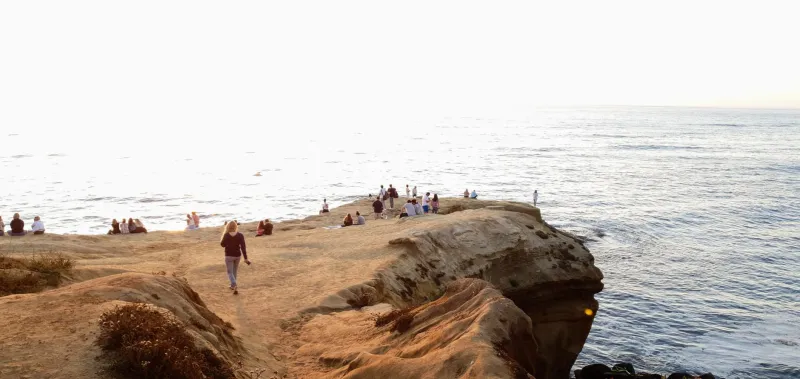
Conventional golden-hour wisdom says soft, directional light is your friend. At Sunset Cliffs, that advice is only partially true. The west-facing orientation means the last hour of sunlight hits the cliffs almost directly — which sounds ideal until you realize it creates exposure challenges that confuse even experienced shooters.
The sandstone catches warm light beautifully. The ocean below reflects the sky in ways that blow out highlights. The shadows in the crevices of the cliff face go almost completely black. Your camera's metering system will try to average all of that and produce an image that satisfies nothing.
The photographers who handle this best tend to shoot in RAW format and deliberately expose for the highlights — accepting that the shadows will need recovery in post-processing. The alternative, exposing for the midtones, typically produces washed-out skies and a flat overall image. If you're shooting JPEG, consider bracketing exposures and blending them later, or using a graduated neutral density filter to bring the sky closer to the foreground exposure in-camera.
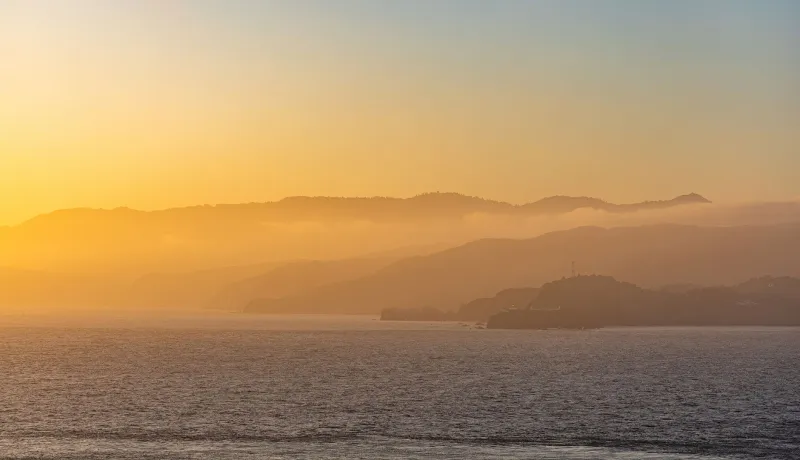
One approach that experienced Sunset Cliffs photographers consistently recommend: shoot slightly earlier than you think you need to. The 45-minute window before the sun actually touches the horizon often produces more workable light than the final descent, when the contrast becomes extreme.
When the Rule of Thirds Stops Working
Here's the thing about Sunset Cliffs that most photography guides won't tell you: the cliffs themselves are visually chaotic in a way that resists clean compositional geometry. The rock faces are fractured, layered, and irregular. The tide pools don't arrange themselves into tidy foreground elements. The horizon is almost always competing with interesting mid-ground material.
When you try to force a conventional thirds composition onto this environment, the result often feels cramped or arbitrary. The cliff edge that you've placed on the lower third doesn't read as a leading line — it reads as a dividing wall. The horizon that you've pushed to the upper third gets lost behind the texture of the sandstone.
What tends to work better is a more centered, symmetrical approach in specific circumstances — particularly when shooting into sea caves or arches where the framing is built into the geology itself. The cliffs have several natural arches and cave openings that create their own compositional structure, and working with that geometry rather than imposing a grid on top of it produces stronger results.
Flat compositions that compress the foreground cliff texture against the ocean background — using a longer focal length than you'd typically choose for landscapes — also perform surprisingly well here. The 70-200mm range that most landscape photographers barely touch turns out to be genuinely useful at Sunset Cliffs for isolating sections of the cliff face and the surf below.
Equipment Considerations That Actually Matter
The salt air at Sunset Cliffs is hard on camera gear in ways that aren't always obvious. Spray from breaking waves can travel considerable distances, and the wind direction shifts frequently. A few practical notes:
A UV or protective filter on your lens isn't just a theoretical precaution here — it's a practical buffer against spray. Cleaning salt residue off a filter is considerably less stressful than cleaning it off a front element.
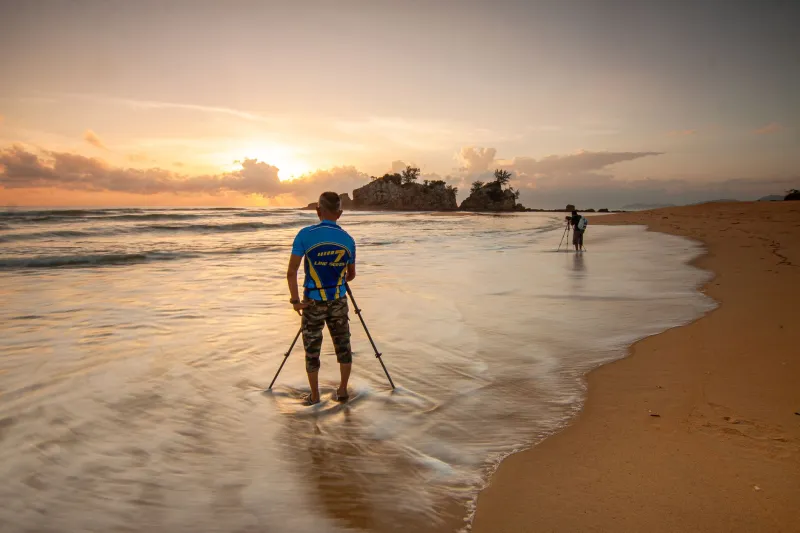
A sturdy tripod matters more than the lens you're using in many situations. The cliffs are windy, and the long exposures that produce the most interesting water movement effects require a stable platform. Carbon fiber tripods with good leg locks are worth the investment if you're visiting more than once.
For drone photographers, it's worth knowing that portions of Sunset Cliffs fall within or near controlled airspace, and the park itself has restrictions on drone use. Check current regulations before you fly — the rules have evolved and enforcement has increased as the area's popularity has grown.
Timing Beyond Golden Hour
Golden hour gets all the attention at Sunset Cliffs, and understandably so. But several other windows produce images that are less common and often more interesting precisely because fewer people are shooting them.
Blue hour — the 20 to 30 minutes after sunset when the sky transitions from orange to deep blue — turns the tide pools into mirrors and gives the cliffs a cool, almost otherworldly quality. Long exposures during blue hour smooth the water to glass while retaining detail in the cliff faces. These images look like nothing else from the location.
Overcast mornings, when most visitors stay away, create diffused light that reveals cliff texture and color in ways that direct sunlight actually obscures. The sandstone layers — red, tan, and gray — show their full range when the light isn't creating harsh shadows. Moody, low-contrast images from overcast mornings at Sunset Cliffs have a documentary quality that performs well in contexts where the typical sunset drama feels overdone.
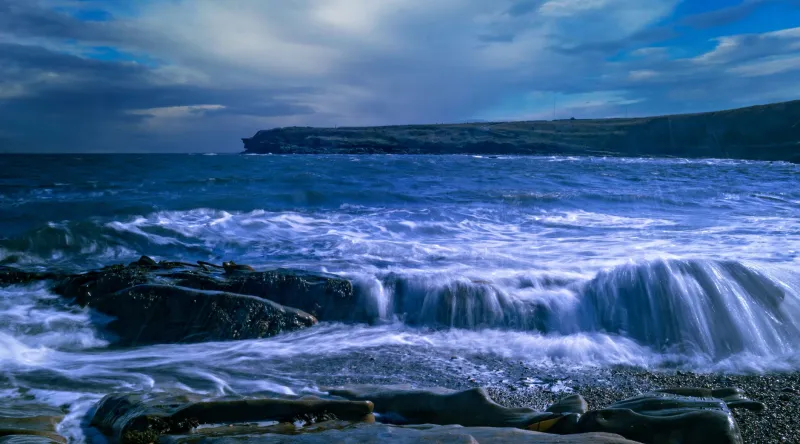
High surf days create something genuinely spectacular: the white water of large breaking waves against the dark cliff faces produces natural contrast that no amount of post-processing can replicate. These are also the most physically hazardous conditions for photography, so positioning matters enormously — stay well back from any edge, use a longer focal length to compress the distance, and never prioritize the shot over your own safety.
The Compositional Advantage Nobody Talks About
For all the ways Sunset Cliffs resists conventional composition, it offers one advantage that most scenic locations simply don't have: genuine geological drama at multiple scales simultaneously.
You can photograph the macro detail of a single weathered rock face and produce an abstract image that reads as pure texture. Pull back slightly and the cliff edge against the ocean creates a graphic two-tone composition. Pull back further and the full sweep of the coastline delivers the classic wide landscape. All three of those images can be made from essentially the same position, just by adjusting focal length and framing.
That scalability — the ability to work at multiple compositional scales within a small area — is what keeps serious photographers returning to Sunset Cliffs long after they've captured the obvious shots. There's always another frame hiding in the geology, another relationship between rock and water and light that hasn't been made yet.
The cliffs break the rules because they're bigger than the rules. Work with that, and the images tend to take care of themselves.